
How to Find Fossils: A US Guide to Searching Legally
Start with exposed rock, check the land rules, and know which finds to leave in place.
Field guide focus
Use this guide as a working reference, not a passive read. Start with the section that matches the question you have in the field.
Table of Contents
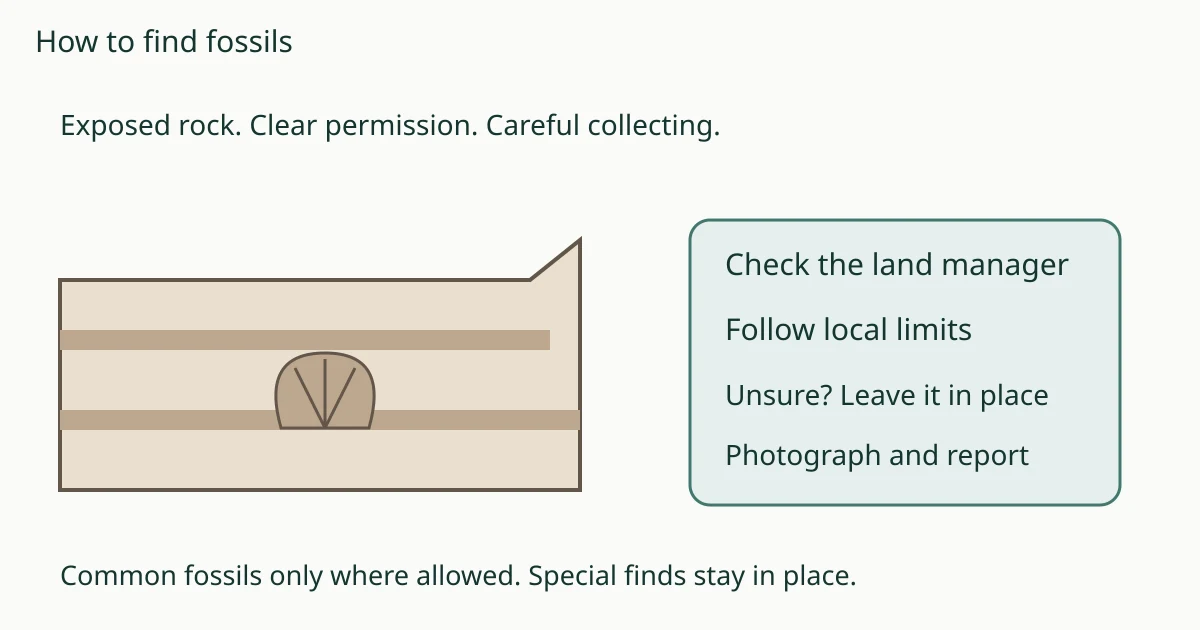
To find fossils, look in exposed sedimentary rock. This rock forms from bits of older rock or the remains of living things that build up at the Earth’s surface. It often has visible layers. Check who manages the land first. BLM and Forest Service rules allow limited personal collection of common invertebrate and plant fossils in open areas. Bones, teeth and vertebrate tracks need a permit. National parks allow no recreational fossil collecting.
Invertebrates are animals without backbones. Vertebrates are animals with backbones. This guide draws on agency rules and museum advice, not field tests. For broader access planning, see our guide to legal rockhounding.
Where Fossils Hide: Sedimentary Rock
The geological bureau FAQ points readers toward exposed sedimentary rock. For fossil hunting, look for this rock where erosion has uncovered its surface. UT Austin lists creek beds, road cuts and quarries as places to check. Freshly eroded surfaces are promising places to look.
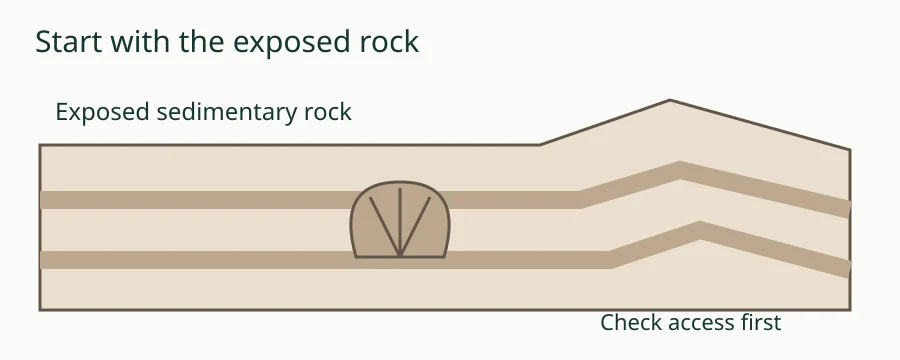
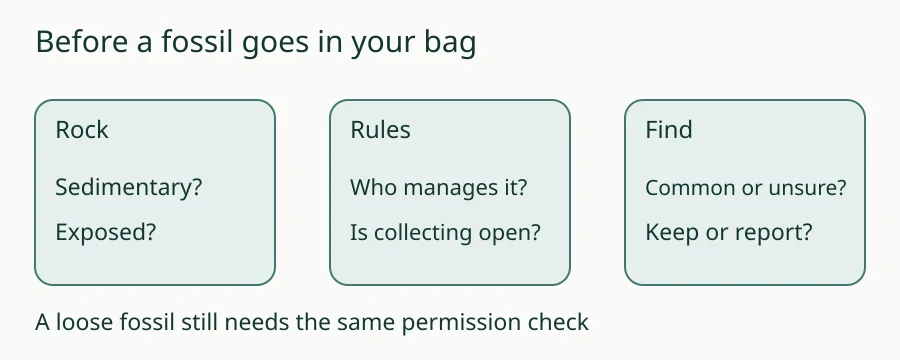
Start by asking what rock is exposed, then whether you may search there. An exposed rock face is a clue, not proof of fossils or permission to collect. Our guide to the three rock types explains sedimentary rock. Use how to read a geological map for help with the map itself.
Places Worth Checking
UT Austin lists creek beds, road cuts and quarries as possible fossil sites when the exposed rock is sedimentary. A road cut is a rock face exposed when a road is built. These are types of places to investigate, not open collecting sites.
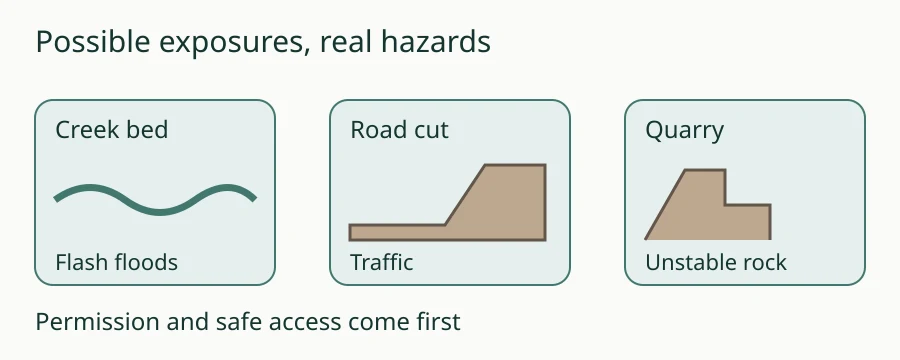
- Creek beds: check access and flood risk. UT Austin warns that some creeks have flash floods.
- Road cuts: avoid busy highways with narrow shoulders. Finding exposed rock does not make stopping or searching safe.
- Quarries and rock faces: get the owner's permission. Watch for unstable rock exposures, another hazard named by UT Austin.
Get permission before digging or removing anything on private land. If access or conditions are unclear, choose another outing. Plan the trip with our rockhounding safety guide.
Check Who Manages the Land First
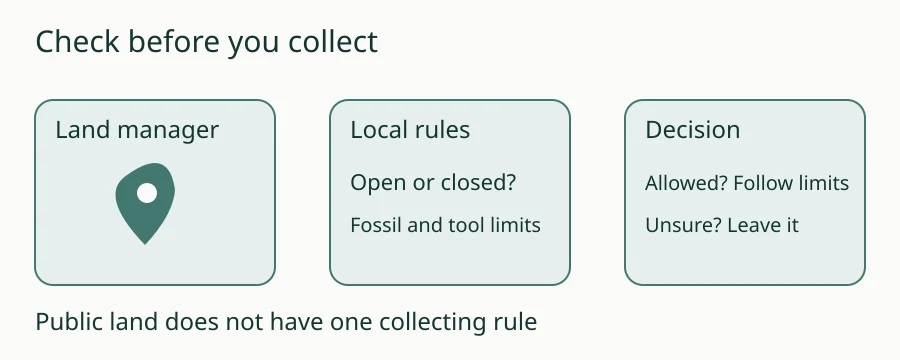
A public-land label is not enough. Federal rules in 43 CFR 49.805 say collectors must find out which bureau manages the land and whether it is open to casual collecting. That means limited collecting for your own use, with little or no disturbance. Ask the local office about closures before you go.
| Land manager | May you keep them? | Limit or condition | Source |
|---|---|---|---|
| BLM | Yes, where open to casual collecting | Up to 25 lb per person per day; personal use only | BLM; §49.810 |
| Forest Service | Yes, on most national forests and grasslands | Up to 25 lb per day AND 100 lb per calendar year; not in National Monuments or closed areas | Forest Service |
| Bureau of Reclamation | Only in designated special use areas for casual collecting | Up to 25 lb per person per day under §49.810; check area rules. No casual collecting on project land managed by NPS/FWS | §§49.805–49.810 |
| National Park Service (NPS) | No casual collecting | No recreational removal, even of loose fossils | NPS; §49.800 |
| Fish and Wildlife Service (FWS) | No casual collecting | Fossil collection requires a permit under the federal rule | §49.800 |
| Private owner | Only with the owner's permission | Ask to enter, collect and keep fossils; federal casual limits do not grant private access | Florida Museum; UT Austin |
| State land: Florida example only | No fossil permit for invertebrates, plants, or shark and ray teeth, where collecting is allowed | Other vertebrate fossils on state-owned or leased land need a permit. Park and local restrictions still apply | Florida Museum permit FAQ |
The Florida Museum example does not apply to federal land. Its FAQ also excludes collecting in state parks and warns that county and river rules differ. Check the relevant state, county or park office. Do not carry a state's tooth exception onto BLM or Forest Service land.
Under §49.810, you may use nonpowered hand tools to remove a larger piece of rock weighing more than 25 lb if needed to keep a common fossil inside it intact. This narrow exception does not cancel local closures or other limits. Ask the office if it affects your plans. This overview is not legal advice or permission for a specific site.
What You May Keep and Must Leave
The Forest Service defines common fossils as those that occur widely and in ordinary numbers. Not every plant or invertebrate fossil is common. BLM lists mollusks (such as snails) as examples that may be common; a name alone does not settle whether your find may be kept.
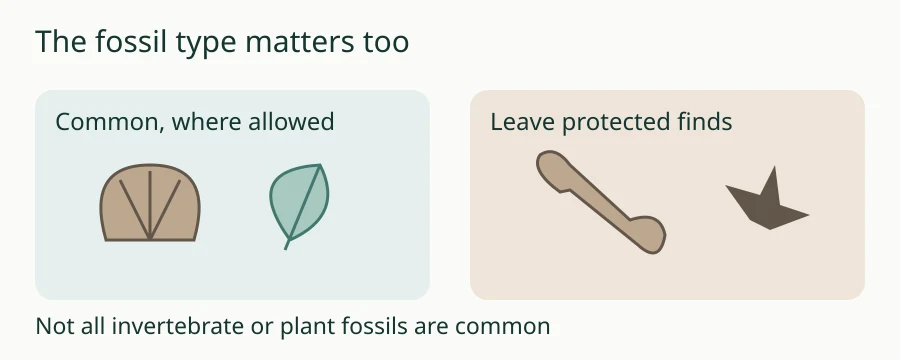
BLM says vertebrate fossils, uncommon invertebrate and plant fossils, and fossil trackways require a research permit. Do not dig them out or make molds or casts. The geological bureau FAQ includes bones, teeth and tracks made by vertebrates among protected finds on federal land. A loose tooth is not a casual collecting exception there.
BLM and Forest Service casual collecting is for personal use, not sale. BLM also says these finds may not be bartered. Fossils are not archaeology: the Forest Service says fossil rules do not cover artifacts, objects linked to human activity. Finding an artifact does not give you permission to take it under fossil rules.
Petrified wood has a separate BLM limit
For petrified wood, BLM allows up to 25 lb plus one piece per day, with no more than 250 lb per person per calendar year. Check local restrictions first. Keep this separate from the ordinary fossil daily limit and the Forest Service annual cap. See our petrified wood guide for the material itself.
How to Search and Collect
Once you know the place and fossil type are allowed, start with the surface and loose rock. The Forest Service advises limiting active digging. It says pairs or small groups are less likely to cause noticeable disturbance.
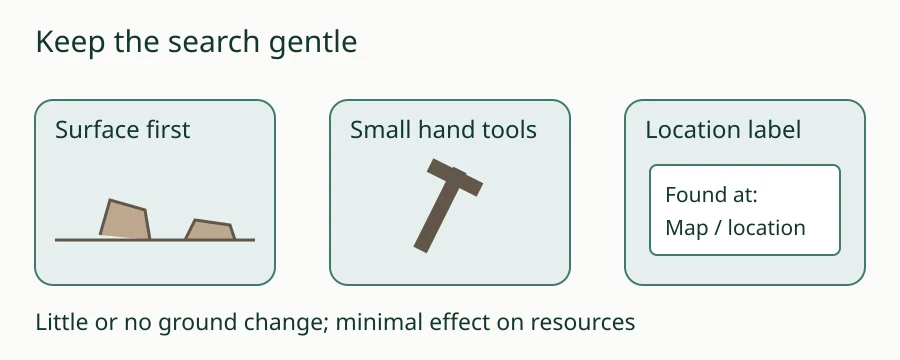
- Look before using a tool. Check loose rock and exposed surfaces first. If you cannot tell what the fossil is, leave it undisturbed and seek expert advice.
- Keep tools small and nonpowered. Forest Service examples include a rock hammer, trowel or sieve. Its definition excludes full-sized shovels and pick axes. Power tools do not fit federal casual collecting rules.
- Keep disturbance negligible. This means little or no change to the ground and minimal or no effect on other resources. Forest Service guidance allows digging or splitting only within that limit.
- Label permitted finds with their location. UT Austin says to record provenance, meaning where the specimen came from. Keep that information with the fossil.
Fossils can be fragile, as UT Austin warns. Taking more is not the aim of the trip. Choose basic supplies with building your first field kit; our rock hammer guide explains existing tool choices. A tool recommendation never overrides a site's rule. Use our rockhounding ethics guide for broader field habits.
Found Something Unusual?
Leave the fossil in place if it may be unusual or you do not know what it is. BLM asks visitors to photograph possible special finds, record their location and report them to a local BLM office. The Forest Service also asks collectors to seek advice rather than disturb an uncertain find.
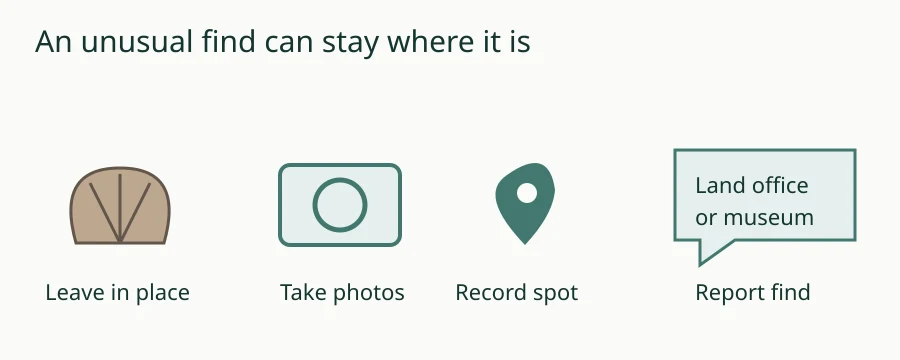
- Take photos while leaving the fossil where it lies.
- Record the spot on a map or with GPS so staff can find it again.
- Contact the BLM or Forest Service office for that land, or a paleontology museum. In a national park, tell a ranger.
How to identify fossils without taking them
Start with photos and the location record. UT Austin advises asking an expert to identify unusual finds. A paleontologist is a scientist who studies ancient life. Museum or university experts can help with a possible bone or other uncertain fossil, as the geological bureau FAQ explains.
Our limestone fossils guide and fossil coral guide cover those materials. They do not confirm that a fossil is common or legal to keep. For more involvement, the Forest Service suggests asking museums and universities about volunteer work on permitted fossil projects.
Fossil Hunting FAQ
These answers follow the BLM, Forest Service, federal casual collecting rule, NPS and UT Austin sources above. Always check the rules for your exact spot.
Can you keep fossils you find?
It depends on the fossil and who manages the land. BLM and Forest Service guidance allows limited personal collection of common invertebrate and plant fossils in open areas. Ask the local office first. On private land, get the owner's permission to collect and keep them.
Is it legal to collect fossils on public land?
Public land has no single collecting rule. BLM and Forest Service lands allow some casual collecting, with closures and limits. Reclamation allows it only in designated special use areas. NPS and FWS lands do not allow casual fossil collecting.
Can I collect fossils in a national park?
No recreational fossil collecting is allowed in any National Park System unit, according to NPS. Even a loose fossil must stay. Photograph it, record the location and tell a ranger.
Where is the best place to look for fossils?
Start with exposed sedimentary rock where collection is allowed. UT Austin lists creek beds, road cuts and quarries as possible places where fresh rock is exposed. Check permission, flood risk, traffic and unstable rock before searching.
What should I do if I find a dinosaur bone?
Leave it in place. Take photos, record the location on a map or GPS, and contact the land manager or a paleontology museum. BLM says vertebrate fossils and trackways on its land need a research permit; they are not casual collecting finds.
Your next step
Use the rules, then pick a site you can verify.
Recommended next step
Find a legal collecting site
Browse detailed location guides across the US.
Sources & References
- Can I Collect Fossils? — Bureau of Land Management
- Leave No Trace—Protect Fossils — National Park Service
- 16 U.S.C. 470aaa-5: Prohibited acts — U.S. Code via Cornell LII
- 16 U.S.C. 470aaa: Definitions — U.S. Code via Cornell LII
- Fossils: A Guide to Casual Collecting — U.S. Forest Service
- 43 CFR Part 49, Subpart I — eCFR
- Where do you find fossils? — UT Austin, Jackson School Museum of Earth History
- Fossil Laws, Regulations, & Policies — National Park Service
- Florida Fossil Permit FAQs — Florida Museum
- FAQ: Fossil Identification and Collecting — New Mexico Bureau of Geology & Mineral Resources
- Can I Keep This? — Bureau of Land Management
- What are sedimentary rocks? — U.S. Geological Survey

Founder and editor, The Rockhounding Hub
Marvin runs this site and is still learning rockhounding. He builds each guide from maker specs, safety rules, and public sources.