TANK007 K9-A5
A longwave option when USB power is your priority: the recorded listing identifies 365nm output and USB power. Its included UV-pass filter is unconfirmed. Compare the uvBeast V3 if a documented filter is essential.
Choose it for
Comparing an explicitly named 365nm flashlight and its USB power setup.
Look elsewhere if
An explicitly documented filter, verified brightness result or shortwave output is essential.
Tool review
Use this page to figure out whether the tool deserves pack space, not just to skim a shopping list.
Table of Contents
For a first rockhounding flashlight, start by comparing 365nm longwave UV lights. Choose the uvBeast V3 when a documented filter matters, the TANK007 K9-A5 when USB power is your priority, or compare the smaller Convoy S2+ package. None of these is a 254nm shortwave lamp.
A filter reduces visible light from the lamp, which can make a faint glow easier to see. Filter status is confirmed for the uvBeast, but remains unconfirmed for the TANK007 and package-dependent for the Convoy. These comparisons use published specs; we have not tested the three lights side by side.
As an Amazon Associate, The Rockhounding Hub earns from qualifying purchases. If you buy through a product link, we may earn a commission. Amazon sets the checkout price; our link does not add a separate fee.
Best UV Light for Rockhounding: Quick Answer
Pick the light that fits your power setup and filter needs. Check the exact 365nm version before ordering: a similar-looking 395nm or 405nm model is not the same purchase.
For a documented filter
uvBeast V3 365nm
Built-in filter and two rechargeable 18650 cells, according to uvBeast. A candidate for scanning ground under longwave UV.
Main trade-off: Larger setup; the maker states a 2–3 hour average runtime. No verified IP rating here.
Check price on AmazonAffiliate link — we may earn a commission. You pay no extra.For a USB-powered setup
TANK007 K9-A5
The checked listing identifies 365nm and USB power. Compare it when that power setup fits your kit.
Main trade-off: An included UV-pass filter is unconfirmed. Do not buy it assuming it is filtered.
Check price on AmazonAffiliate link — we may earn a commission. You pay no extra.For a smaller handheld option
Convoy S2+ UV
A 365nm handheld candidate for close specimen checks. Compare the complete package, not just the flashlight price.
Main trade-off: Confirm the filter, battery and charger separately; packages vary.
Check price on AmazonAffiliate link — we may earn a commission. You pay no extra.Looking for shortwave UV for minerals? Go straight to the 254nm lamp buying checklist. A longwave flashlight cannot substitute for that wavelength.
Why You Need a UV Light
Fluorescence can make a specimen look different under UV than it does in white light. That gives you another observation to record:
- Notice a response. A glow marks a specimen for a closer look.
- Compare wavelengths. Record whether the response was seen under longwave, midwave, or shortwave; those labels are not interchangeable.
- Identification clue. Fluorescence can narrow a shortlist, but it is not enough to identify a mineral by itself. Record it as one observation.
- Compare in white light.Carry a separate white light so you can record the same specimen's normal-light appearance.
Wavelengths Explained
Start with the wavelength printed in the current product listing. The Fluorescent Mineral Society separates longwave UVA, midwave UVB, and shortwave UVC because lamps and filters are designed for a specific part of the UV spectrum.
| Wavelength | Type | What the source establishes | Buying consequence |
|---|---|---|---|
| 254nm | Shortwave (SW) | Common shortwave mineral lamps emit mainly at 254nm and use a filter to suppress visible light. | Use a purpose-built unit and follow its UVC safety instructions. |
| 365nm | Longwave (LW) | Near 365nm is part of the longwave UVA range used by blacklight and handheld-lamp designs. | Several verified handheld product identities are available. |
| 395–405nm | Blacklight | A different longwave range. Check the exact wavelength and filter, then note the visible spill on the live listing. | Do not treat 395–405nm as interchangeable with 365nm. |
Filtered vs. Unfiltered
A UV lamp can emit visible light alongside UV. The Fluorescent Mineral Society explains that an external filter may be used to suppress that visible component.
That does not mean every dark lens in a product photo is a confirmed UV-pass filter. Check the written package description and the lamp maker's compatibility instructions.
Bottom line: record wavelength and filter status as two separate facts. If the listing does not state the filter, treat it as unconfirmed.
Best Longwave (365nm) Lights
TANK007 K9-A5: USB-Powered 365nm Option
The current Amazon title identifies this model as a 365nm, USB-powered UV flashlight. That is enough to compare wavelength and power setup without inventing a brightness result. The retrieved listing did not establish an included UV-pass filter.
uvBeast V3 365nm: Documented Long-Range Option
uvBeast's current product page states that the package has a built-in filter, three 365nm LEDs, and two rechargeable 18650 cells. Confirm the Amazon package before checkout because listings can change. uvBeast states a 60 ft+ beam, which makes distance the reason to consider it in this guide. Read the weight and runtime limits below before opening Amazon. Water resistance needs its own check.
Quick verdict
uvBeast states a 60 ft+ range. Choose it when that stated range fits how you search and the documented weight does not bother you.
Skip it when
You only check one specimen at a desk, need verified wet-weather protection, or want a 254nm shortwave lamp.
We have not field-tested this flashlight. The facts below come from the exact Amazon identity and uvBeast's current product page. Output and range numbers remain uvBeast claims, not our measurements.
Who the uvBeast V3 fits
- Rockhounds checking longwave fluorescence while moving over dark tailings or open ground.
- Collectors who want a documented filter instead of assuming one from a product image.
- Users willing to carry charged 18650 cells for a longer hunt.
Who should skip it
- Someone who wants a small light for close inspection or pocket carry.
- Someone who needs a full night from one charge. uvBeast states an average of two to three hours per charge.
- Anyone who needs waterproof or submersible equipment. The retrieved Amazon details say “water resistant” but give no verified IP rating.
- Collectors buying for specimens that require shortwave UV. This is a longwave UVA light, not a 254nm UVC lamp.
Documented uvBeast V3 specifications
| Light | Filtered 365nm output from three UV LEDs |
|---|---|
| Claimed output | uvBeast states 1,800 µW/cm² per LED and 5,400 µW/cm² total; not independently measured here |
| Claimed range | uvBeast states 60 ft+; not independently measured here |
| Power package | uvBeast lists two protected 2600mAh 18650 cells, a two-bay USB charger, and a US adapter |
| Other listed items | Spare O-rings and an extension barrel; confirm the live Amazon package |
| Size and weight | Amazon lists 8.66 × 2.17 × 0.91 in and 377 g |
What 365nm changes in the field
At 365nm, you are checking for longwave fluorescence as you move the beam over dark ground or a specimen. That can reveal a response in suitable material, but it cannot reveal every shortwave response. The Fluorescent Mineral Society explains that response varies by specimen and wavelength.
The same source explains that lamp filters absorb visible light while passing UV. The purpose is to reduce visible spill from the lamp. This product's filter is documented by uvBeast; we did not measure its transmission.
Buyer signals, checked August 31, 2026
Amazon displayed 4.7 out of 5 from 3,245 ratings and “200+ bought in past week.” Those values change, so they are a dated signal rather than a permanent product fact. The uvBeast store separately displayed 307 product reviews; these review pools are not combined.
Reviews on the maker's site include praise for coverage and distance. Individual critical comments mention heat, an early charger problem, and the lack of a separately sold replacement lens. These comments identify things to check; they do not establish failure rates.
Convoy S2+: Compact 365nm Candidate
The linked Convoy S2+ is the handheld 365nm UV version. Package contents can vary. Confirm the filter and battery, then check whether a charger is included. Do not assume the ZWB2 filter is included.
When to Add a 254nm Shortwave Lamp
A common shortwave mineral lamp emits mainly at 254nm, which is UVC. Add one only when a target specimen or collecting guide gives you a clear reason to compare shortwave response. Buy a purpose-built lamp with documented wavelength, filter, operating instructions, and safety requirements. We do not recommend an Amazon shortwave unit here because we have not verified an exact package to that standard.
What to check before buying a 254nm mineral lamp
- Your target specimen. Look up its response by wavelength. A longwave glow does not tell you what shortwave will reveal.
- Exact output and filter. Require a stated 254nm output and a filter designed for that lamp, rather than a generic blacklight label.
- Field or display use. Check whether it runs from a battery or wall power, and whether the maker gives a runtime for that setup.
- Complete setup. Include the power supply, replacement-lamp or filter availability, and maker-specified protection when comparing cost.
Our fluorescent mineral hunting guide explains how to plan the hunt. Choose a lamp for those specimens and conditions, rather than buying shortwave just because it sounds more powerful.
How to Avoid the Wrong UV Light
- Require an exact wavelength. Do not buy from the word UV alone; look for 365nm, 395nm, 405nm, or 254nm in writing.
- Check filter status separately. A dark-looking lens in a photo is not proof that a UV-pass filter is included.
- Read the power setup. Confirm whether batteries, a charger, or a USB cable are included in the current package.
- Treat output language carefully. Beam range and power claims from a seller are not independent field-test results.
What Minerals Fluoresce?
These examples come from the Fluorescent Mineral Society's common minerals guide. A label such as LW, MW, or SW records the wavelength used for that example; it does not promise the same result for every specimen.
| Mineral | Fluorescence Color | Wavelength | Source-backed note |
|---|---|---|---|
| Calcite | Many possible colors | LW, MW & SW | The Society describes calcite as a very diverse fluorescent mineral. |
| Fluorite | Usually blue; other colors occur | LW | The listed example is a longwave response. |
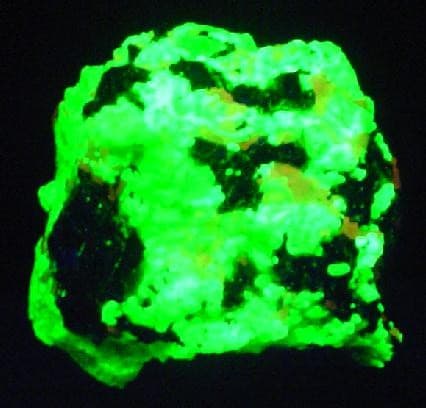
| Willemite | Green | SW | The Society lists green, with white or yellow also possible. |
| Sodalite | Orange | LW | The Society lists an orange longwave response. |
| Scheelite | Blue-white | SW | The Society lists bluish white, with red rare in midwave. |
| Opal | Chartreuse; yellow is rare | LW, MW & SW | The entry is for fluorescent common opal, not every opal. |
| Selenite/Gypsum | Bluish white | LW & SW | The Society also lists midwave examples for selenite. |
| Ruby / Corundum | Red | LW | The Society lists ruby and sapphire as corundum varieties. |
| Aragonite | Yellow, white, or bluish | LW & SW | Compare the observed response with a mineral reference. |
| Scapolite | Yellow or red | LW & SW | The Society also lists midwave examples for scapolite. |
For a deeper dive into fluorescent mineral hunting, see our fluorescent mineral hunting guide.
Field Tips for UV Collecting
- Record ambient light. Note whether you observed the specimen in shade or darkness so you can repeat the comparison.
- Carry a white light too. When you spot something fluorescent, switch to white light to record its normal-light appearance. A 10x loupe adds a magnified observation. Neither the glow nor magnification identifies a mineral by itself.
- Write down the setup. Record the lamp wavelength and filter status beside your specimen notes.
Our Recommendation
- USB-powered option: TANK007 K9-A5. The checked listing states 365nm and USB power. Its included filter remains unconfirmed.
- Filtered long-range option: uvBeast V3. The filter is documented; treat its 60 ft+ range as an uvBeast claim and check the live package, weight, and runtime before buying.
- Shortwave later:add a purpose-built 254nm lamp only for a defined need and with the maker's UVC safety instructions.
Compare the three 365nm options and their trade-offs ↑
Ready to try UV collecting? Read our fluorescent mineral hunting guide for field techniques, or browse collecting locations to find sites with documented fluorescent material.
Frequently Asked Questions
Start with a 365nm longwave flashlight for a first comparison. The uvBeast V3 has a maker-documented filter; the TANK007 K9-A5 is a USB-powered option with an unconfirmed filter. Compare the Convoy S2+ for a smaller handheld setup, checking its filter, battery and charger package. None replaces a 254nm shortwave lamp.
A UV response is a reason to inspect a specimen, but it cannot confirm that the specimen is agate. Record the wavelength, compare the rock in white light, and add hardness plus other identification clues before naming it.
There is no single wavelength that produces the same response in every mineral or specimen. Start with a documented 365nm handheld light for an accessible field setup. Add a purpose-built shortwave unit only when your target specimens and safety plan call for it.
A 365nm longwave flashlight is a practical first comparison for a handheld setup. Check that your target specimens respond at that wavelength. A common shortwave mineral lamp emits mainly at 254nm UVC and requires stricter handling.
Both are in the longwave UVA range, but they are not the same wavelength. Check the exact number instead of relying on the word blacklight. Visible spill and mineral response depend on the lamp and filter as well as the specimen.
A UV-pass filter can suppress visible light emitted by the lamp, which can make fluorescence easier to judge. Do not assume a filter is included from a product photo; check the current package description.
Yes. The FDA says UVC can cause skin burns and eye injury and warns against direct skin exposure or looking into a UVC source, even briefly. Follow the lamp maker's instructions and use the protective equipment specified for that exact lamp.
Fluorescent specimens emit visible light while they are exposed to suitable ultraviolet radiation. The result depends on the mineral and specimen as well as the wavelength, lamp and viewing conditions. Fluorescence is a clue rather than a complete identification.
Your next step
Got your gear? Now plan your first trip.
Recommended next step
Find a site to use your gear
Browse collecting locations with access info, GPS coordinates, and site-specific gear requirements.
Sources & References
- UV Light Recommendations from r/rockhounds — Reddit
- Best UV Lights for Rockhounding — Oregon Discovery
- UV Lights: wavelengths and filter behavior — Fluorescent Mineral Society
- Common Fluorescent Minerals: example colors and wavelengths — Fluorescent Mineral Society
- Ultraviolet radiation: UVC eye and skin risk — U.S. Food and Drug Administration
- uvBeast V3 365nm: official specifications and package contents — uvBeast
- uvBeast product reviews — uvBeast

Founder and editor, The Rockhounding Hub
Marvin runs this site and is still learning rockhounding. He builds each guide from maker specs, safety rules, and public sources.