
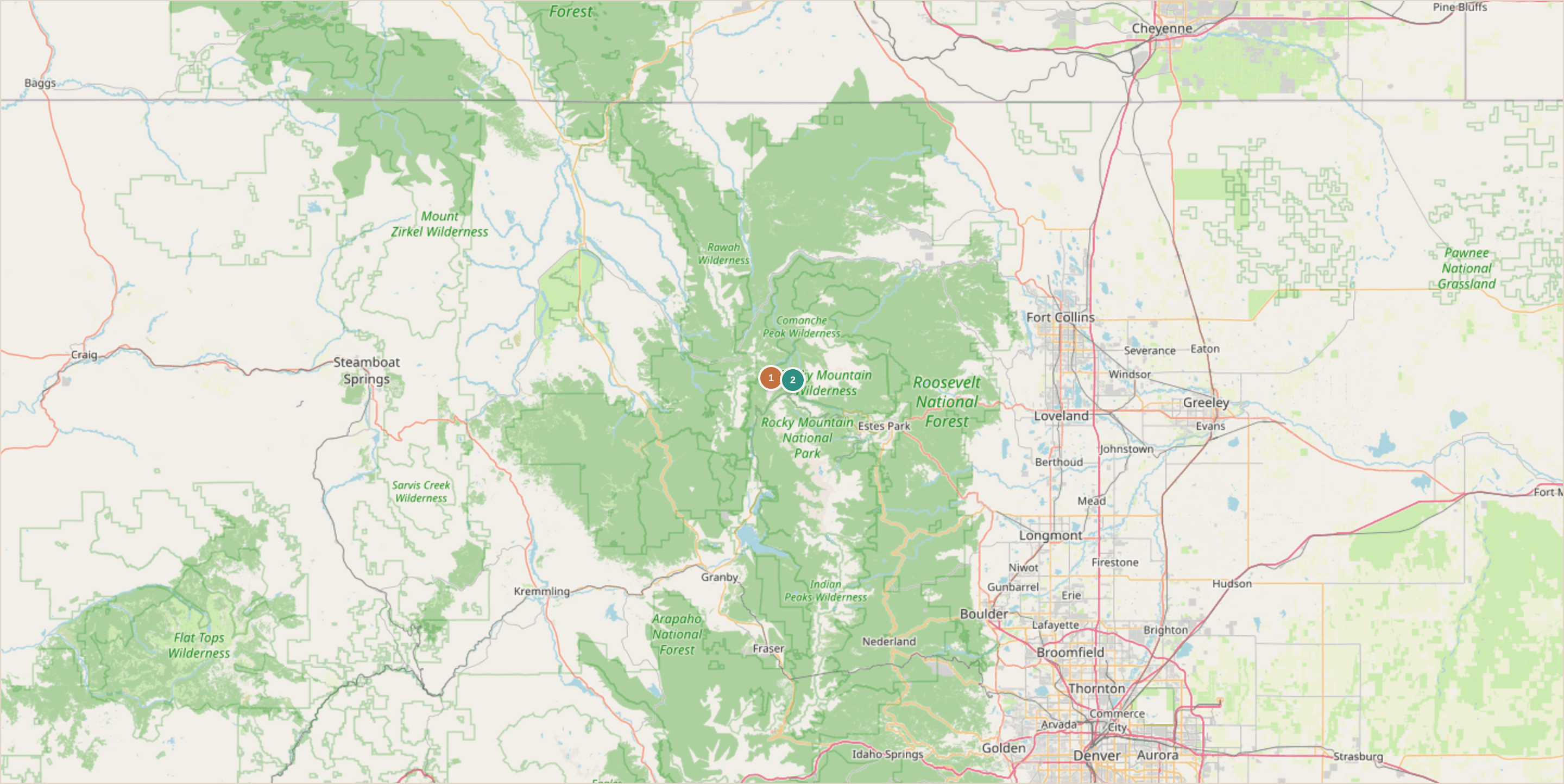
 © OpenStreetMap contributors
Table of Contents
Legal collecting in Colorado starts with land status, not with the name of a peak or the romance of alpine geology. That is not an abstract rule; it is the main lesson of the current Colorado coverage, which is anchored in Specimen Mountain inside Rocky Mountain National Park.
Colorado has enough mineral history to tempt writers into broad claims, but broad claims are not useful if the access logic is wrong. The honest Colorado starting point is simple: some of the state's best-known mountain landscapes are for observation only, and a good collector learns that boundary before planning the next trip.
Best Rockhounding Sites in Colorado
In the current state coverage, Colorado is less about a take-home site list and more about a useful decision framework: know what is closed, know what is educational, and do not confuse scenic geology with legal collecting access.
Specimen Mountain closure area
The current Colorado location coverage is anchored in a place where collecting is not allowed. Rocky Mountain National Park rules prohibit removing natural resources, and the Specimen and Shipler Mountain closure area is closed year-round to protect wildlife.
Tip: Use this as a Colorado planning lesson: a famous name on a map is not the same thing as a legal collecting destination.
Rocky Mountain National Park geology viewpoints
The National Park Service's geology material still makes the park worth visiting as an education stop. In the current site coverage, the practical value is observation, not take-home material.
Tip: Use visitor centers, pullouts, and designated viewpoints to build geologic context before planning a separate legal collecting trip elsewhere in Colorado.
Collecting by Access Type
The current Colorado page is intentionally access-first rather than district-first. That is because current site coverage supports a strong legal lesson better than it supports a padded statewide minerals list.
National park terrain belongs in one category: observe, learn, and leave everything in place. Colorado collecting trips outside that category should be planned as separate outings with separate land-manager logic.
Rocks and Minerals You Can Find in Colorado
Rocky Mountain National Park still teaches a lot: ancient crystalline rocks, glacial landforms, and high-country terrain that explain why Colorado geology is so compelling in the first place. The point here is to read the landscape, not remove it.
Colorado Rockhounding Rules, Permits & Legality
The National Park Service rule set is the spine of the current Colorado guide. Natural resources cannot be removed or disturbed, and the Specimen/Shipler closure zone is closed year-round to protect bighorn sheep. That makes the legal answer unusually clear.
Best Time to Go Rockhounding in Colorado
Summer and early fall are the easiest windows for alpine observation because roads and visitor services are more available, but the season never changes the collection rules. A closed collecting area does not become open because the weather is nice.
Recommended Gear
Layers, water, sun protection, good footwear, and a camera are more useful here than specimen buckets. The point is field observation.
Safety Tips
- Respect wildlife closures and posted access boundaries.
- Prepare for altitude, weather changes, and exposed mountain conditions.
- Use designated access rather than inventing a better route.
Common Mistakes
- Assuming a famous mountain name implies legal collecting.
- Treating national-park geology as hobby-collecting ground.
- Using Colorado mineral lore instead of current land-manager rules.
Location pages in Colorado
Specific destinations currently covered inside this state guide.
Community
Recent discussion in Colorado
Trip notes, collecting updates, and local questions tied to this state guide.
Local discussion loads after the page is ready so the guide itself stays fast and fully readable.
Loading recent discussion for this area...
Planning your first collecting trip?
Most beginners skip the preparation step. Don’t — our beginner’s guide covers gear, safety, and field ID basics that’ll save you time and frustration.
Frequently Asked Questions
No. Rocky Mountain National Park prohibits removing natural resources, and the Specimen Mountain closure area is closed year-round to all travel.
Because the current Colorado coverage proves the point clearly: the name of a mountain does not matter if the land manager forbids collecting. In Colorado, land status is the first filter, not the last.
No. It means the current site coverage is being honest about what it documents right now. Colorado has major mineral history, but this state page refuses to invent collecting access where the current sources do not support it.
Your next step
Heading to Colorado? Read this before you go.
Recommended next step
Learn to identify what you find in Colorado
Practical field tests for the minerals at this site — streak, hardness, luster, and crystal habit.
Sources & References
- Rules & Regulations - Rocky Mountain National Park — National Park Service
- Area Closures to Protect Plants & Animals — National Park Service
- Geologic Activity - Rocky Mountain National Park — National Park Service
- NPS Geodiversity Atlas - Rocky Mountain National Park, Colorado — National Park Service