
How to Open a Geode Safely: Methods Compared
Choose a method for the finish you want, protect your eyes, and expect a surprise inside.
Field guide focus
Use this guide as a working reference, not a passive read. Start with the section that matches the question you have in the field.
Table of Contents
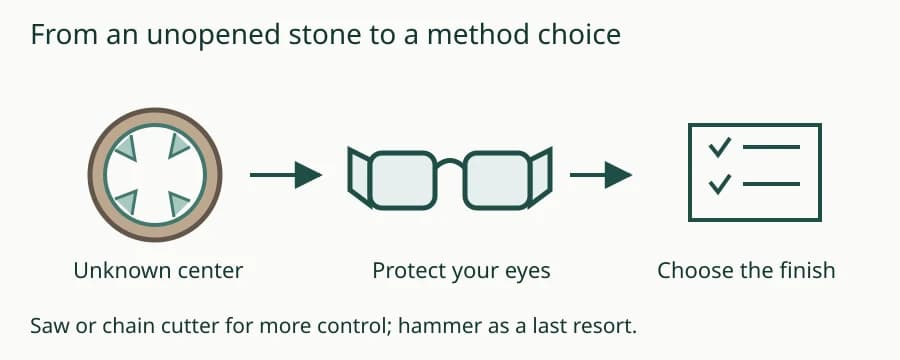
To open a geode, put on impact-rated eye protection with side protection first. Choose a rock saw or chain-style pipe cutter for more even halves; a scored groove with a chisel or the sock method offers a simple hammer option, but a hammer is a last resort. No method promises a hollow center or perfect halves.
These steps draw on named collectors in Rock & Gem, geological surveys and workplace safety sources. For help with the stone itself, see our geodes and thunder eggs guide.
What to Check Before You Open a Geode
A rough, bumpy shell can hide an empty pocket, a partly filled center or solid minerals. The Kentucky Geological Survey warns that bumps do not prove a geode is hollow. Do not choose a method based on the outside alone.
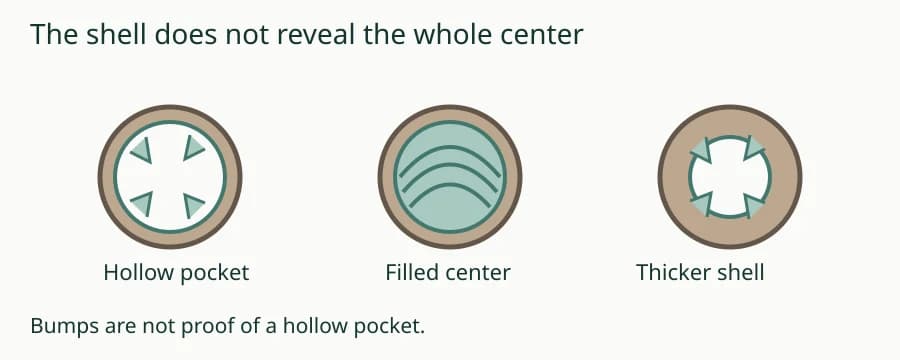
The Illinois Geological Survey says hollow geodes are lighter than fully filled ones. Compare similar sizes, and treat the feel as a clue. A light rock alone does not prove you have a geode.
Wall thickness matters too. Dusty Atkinson of the Geode Guys, a father-and-son geode team, explains that a thin shell around a large hollow can be easier to crack than a smaller stone with thick, hard agate. Agate is banded quartz. Size alone does not tell you how hard opening will be.
A concretion grows around a central core. In a crystal-lined geode, crystals grow inward from the shell. That is a useful distinction, not a hollow-rock test: the Australian Museum notes that some concretions are hollow too. Set your goal before you start: a flat display face, a natural split, or just a look inside.
Safety Setup First
Flying chips are a risk during chiseling and sawing. Use impact-rated eye protection with side protection. The FWS selection chart names ANSI/ISEA Z87.1, a standard for eye and face protection. It calls for goggles for sawing and fine particles, and a face shield over glasses or goggles for severe exposure.
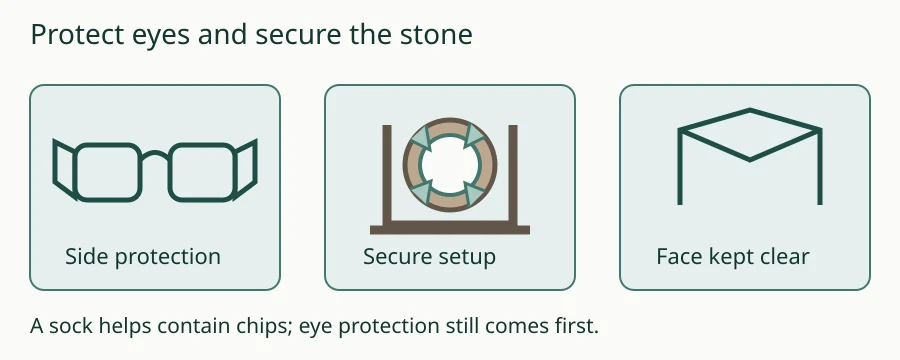
OSHA 1910.133 requires side protection for workers exposed to flying objects. Ordinary prescription glasses do not replace protective eyewear. If you wear them, choose protection that fits over them without moving either pair, or protective prescription lenses.
- Use a stable work surface and secure the geode with a suitable clamp. Keep hands out of the strike or cut path and your face away from the opening.
- Keep other people clear of flying chips. A sock helps contain fragments; it is not a substitute for eye protection.
- Mineral collector Taylor, known as AgateDad, advises eye and ear protection in Rock & Gem. He also says he chooses a respirator when cutting minerals. That is his practice, not a complete respirator selection guide.
The Illinois geode source describes some petroleum-filled specimens that can squirt when broken. This warning concerns Illinois geodes, not every geode from every place. Keep your face away even when you expect dry crystals.
OSHA rules cited here protect employees and place duties on employers. Hobby collectors can use them as safety references; they are not a promise that a home setup is safe. This is not medical advice. See our rockhounding safety guide for wider trip planning.
Choose Your Method
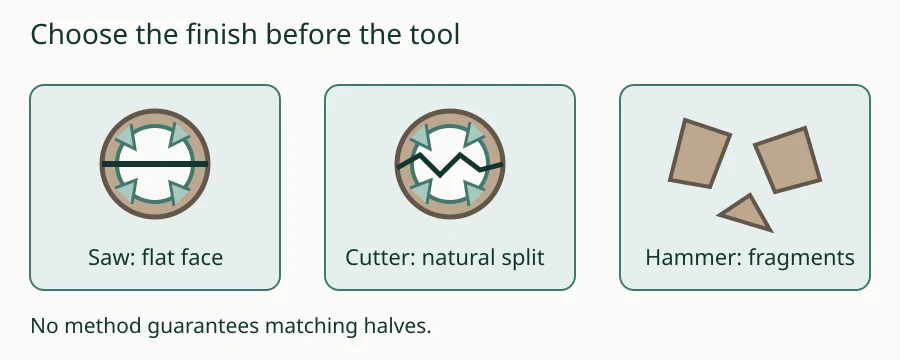
Decide how much control you want over the break. In Rock & Gem, Southern California rough-cut gems and minerals supplier John E. Garsow favors a diamond-coated rock saw, followed by a chain-style pipe cutter. He calls a hammer the “tool of last resort.”
| Method | Best for | Even halves? | Source |
|---|---|---|---|
| Hammer and masonry chisel | A simple opening when extra pieces are acceptable | Uncertain; may shatter | Garsow / Dusty |
| Scored groove, then hammer and chisel | Guiding the break around the middle | Better odds than striking without a groove; no guarantee | Dusty |
| Sock and hammer | Containing chips during a basic opening | Containment does not control the split | Eric Carlson |
| Chain-style pipe cutter | A natural split with pressure around the stone | Reasonably equal halves, according to Garsow | Garsow |
| Rock or trim saw | A flat cut face | More control over the cut | Garsow / AgateDad / Dusty |
A rotary tool with a diamond wheel can make a score, a shallow groove that guides a later break. It is not the same as cutting through the whole stone. Dusty describes a tile saw as more dangerous and urges extreme caution because it is being used for another purpose. This guide does not give tile-saw instructions.
Hammer and Chisel: Score First
Choose this route only if you accept extra pieces. Dusty says a score around the middle can improve the odds of a more even split. Garsow warns that hammering is likely to shatter a geode. Hitting harder is not a reliable way to get cleaner halves.
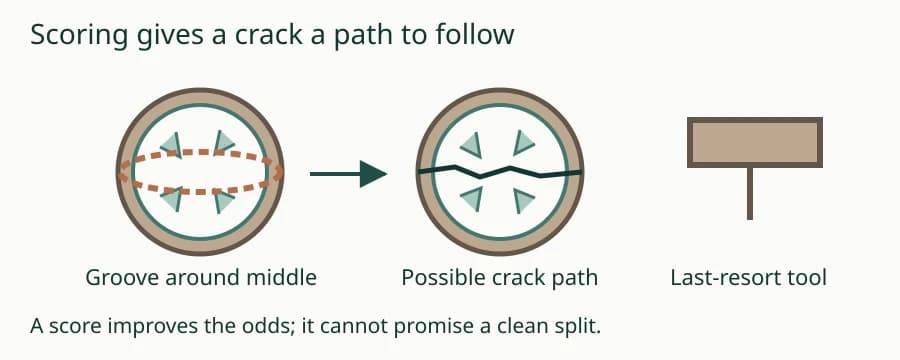
- Choose a line around the middle. Think of an equator around the geode. This is the route for the groove, not just a mark on the surface.
- Score the outside. Dusty describes a diamond-wheel rotary tool for making the groove. Use suitable equipment and its water/dust controls; do not improvise by spraying water onto an unsuitable electric tool.
- Apply the hammer and masonry chisel at the groove. The weakened line may guide the crack. It can still break elsewhere or leave more than two pieces.
The source does not give a fixed tapping force or a guaranteed number of blows. Do not treat this as a reason to keep increasing force. If neat halves matter, choose a saw or chain cutter instead. Our rock hammer and chisel guide covers the tool types.
The sock method
Eric Carlson of Carlson’s Rock World, a rock shop in Goldfield, Iowa, describes placing a geode in an old sock before hitting it with a hammer. The sock helps hold the pieces and chips. Keep the same eye protection and secure setup. It does not make hammering a controlled split or promise unbroken crystals.
Saws and Pipe Cutters for Cleaner Halves
A rock saw cuts through the stone; a chain-style pipe cutter breaks it by applying pressure around the outside. Garsow describes the chain method as the quickest way to get two reasonably equal halves. AgateDad prefers lapidary saws, saws made for stone work, for a clean, flat face.
These are different finishes. A saw leaves a cut face. A cutter leaves a natural break. Neither can create an empty pocket inside a solid stone. Follow the equipment maker’s setup and holding instructions rather than forcing a geode into a tool that does not fit it. Compare equipment types in our lapidary saw guide.
Control dust while cutting and cleaning up
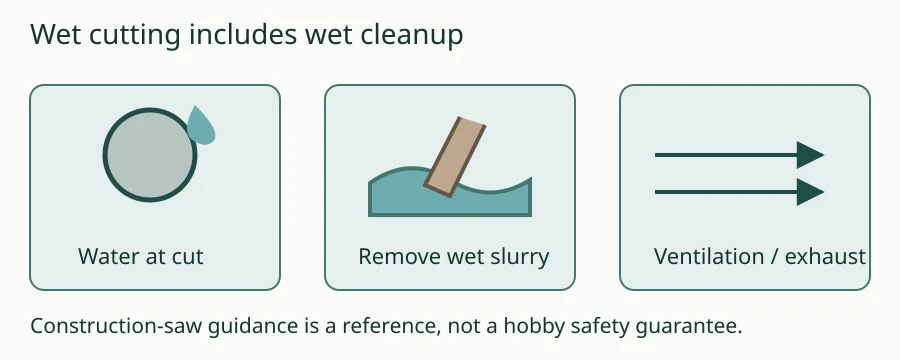
Cutting stone can release fine crystalline silica dust. CDC/NIOSH recommends water methods to suppress dust. The OSHA handheld power-saw fact sheet describes continuous water at the blade and cutting area. Use a saw designed for wet cutting and follow its instructions, including electrical safety. Water and electric equipment need a proper setup.
- Keep the cutting area wet with the equipment’s water system. Do not assume a quick splash is enough.
- Clean up slurry, the wet mix of stone dust and water, before it dries. OSHA gives shovels or a suitable wet vacuum with a HEPA filter as examples. HEPA means a high-efficiency particle filter.
- Do not dry sweep or blow dust away with compressed air, as CDC/NIOSH warns.
- Wet cutting indoors or in enclosed spaces may still need extra ventilation or exhaust to remove dust from the air.
The OSHA sheet is for handheld construction saws, not a geode-saw manual. Its workplace controls are useful references, but do not establish that a hobby saw or room has safe dust levels. Water alone is not proof that dust is controlled.
What You Might Find Inside
Quartz is common, but the center is not always a clear crystal cave. The Kentucky source describes solid quartz, crystal quartz and layered agate. It also lists calcite and dolomite crystals in some geodes. Chalcedony, a fine-grained form of quartz, often makes the outer shell.
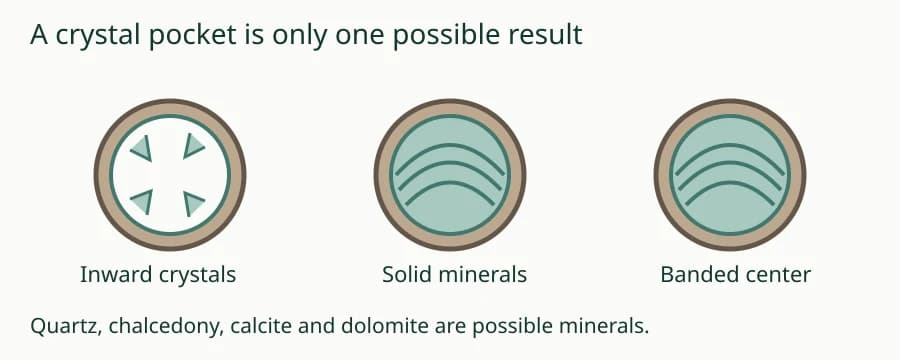
The Australian Museum describes thunder eggs that can fill with agate, chalcedony, quartz or amethyst. A solid patterned center can be the result, rather than a hollow pocket.
If the center is stained or the shell has broken into several pieces, stop hammering and inspect what remains. More blows will not turn fragments back into matching halves. For dirt or stains, use our safe mineral cleaning guide before choosing a treatment. Cleaning is a separate task; this guide gives no acid or polishing recipe.
Common Mistakes When Opening Geodes
The main mistakes come from expecting more control than a method offers. A scored line helps guide a crack, a sock helps contain pieces, and water helps suppress dust. None is a guarantee by itself.
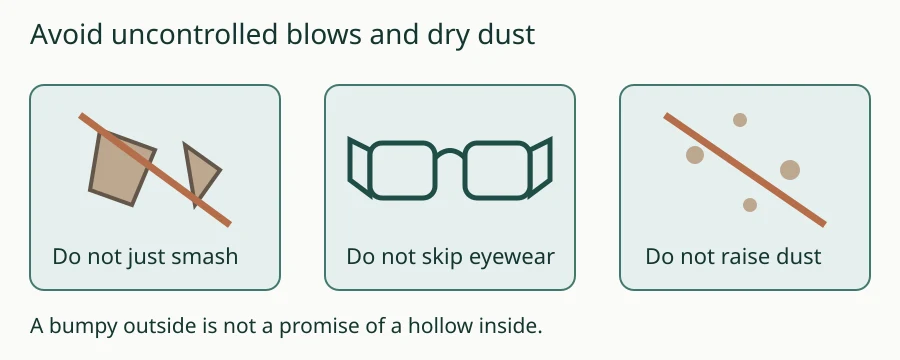
- Hard hammer blows. Garsow warns of shattering; choose the finish, then the method.
- Skipping side protection. Flying chips are an eye hazard, too.
- Tile-saw shortcuts. Dusty warns that this use is more dangerous.
- Dry cutting or dried slurry. Keep wet dust controls through cleanup; add ventilation where needed.
- Expecting a hollow stone. Bumps and size do not reveal the center.
If you plan to collect more geodes, check our guide to legal rockhounding before choosing a site. Opening advice does not tell you where collection is allowed. For basic trip supplies, see building your first field kit.
Geode Opening FAQ
How do you open a geode without a saw?
A chain-style pipe cutter applies pressure around the stone. A scored groove followed by a hammer and masonry chisel is another option. Eric Carlson describes putting a geode in an old sock before hammering it. Hammer methods can leave several pieces, not neat halves.
Can you open a geode without breaking it?
Opening changes the stone. A rock saw cuts through it for a flat face. A chain cutter splits it with pressure. These offer more control than hammering, but neither promises a perfect pair of halves.
Are all geodes hollow?
No. Some are partly filled and others are solid with inward-grown minerals. A bumpy shell does not prove there is an empty pocket. A hollow geode is lighter than a fully filled one of similar size, but weight alone is not proof.
What do you need to open a geode?
Start with impact-rated eye protection with side protection and a secure work setup. Then choose a rock saw, chain-style pipe cutter, or hammer and masonry chisel. Cutting needs suitable water-fed equipment and dust controls. A sock can help contain chips during hammering; it does not replace eye protection.
Is it safe to crack a geode with a hammer?
Hammering can send chips flying and shatter the geode. Supplier John E. Garsow calls a hammer a last resort. Wear impact eye protection with side protection, secure the stone and keep other people clear. Scoring first may guide the break, but cannot guarantee even halves.
Your next step
Use the rules, then pick a site you can verify.
Recommended next step
Find a legal collecting site
Browse detailed location guides across the US.
Sources & References
- How to Open a Geode: Tools and Tips — Rock & Gem Magazine, L.A. Berry
- Geodes — Kentucky Geological Survey
- Geobit 3: Geodes — Small Treasure Vaults in Illinois — Illinois State Geological Survey
- Concretions, Thunder Eggs and Geodes — Australian Museum
- Safe Work Practices: Silica — CDC/NIOSH
- Handheld Power Saws: Control of Silica Dust in Construction — OSHA
- Eye and Face Protection Selection Chart — U.S. Fish & Wildlife Service (supplied search extract)
- 1910.133: Eye and Face Protection — OSHA

Founder and editor, The Rockhounding Hub
Marvin runs this site and is still learning rockhounding. He builds each guide from maker specs, safety rules, and public sources.