
How to Identify a Meteorite: Checks You Can Do at Home
Start with a thin fusion crust, rule out common look-alikes, and use home checks only to decide whether to seek expert help.
Field guide focus
Use this guide as a working reference, not a passive read. Start with the section that matches the question you have in the field.
Table of Contents
To check a possible meteorite, look first for a thin fusion crust, the skin left when its outer surface melted in the air. Then check its pull on a magnet, weight, streak on unglazed ceramic, and inside texture. Large gas bubbles count against it. Most suspected finds are Earth rocks called “meteorwrongs”; only an expert or lab can confirm a meteorite.
This guide draws on university sources, the Meteoritical Society and BLM rules. For a wider look at an unknown stone, start with our field rock identification guide.
Start with the Fusion Crust
A fresh fusion crust is thin and black. It can be matte (dull) or glossy. Weathering can turn it rusty brown. The University of Arizona guide warns about dark coatings such as desert varnish. This coating forms on Earth rocks in dry places. Volcanic skins, slag (waste from metal-making) and chemical rinds (outer coatings) can also fool you. A thick rind is not a meteorite fusion crust.
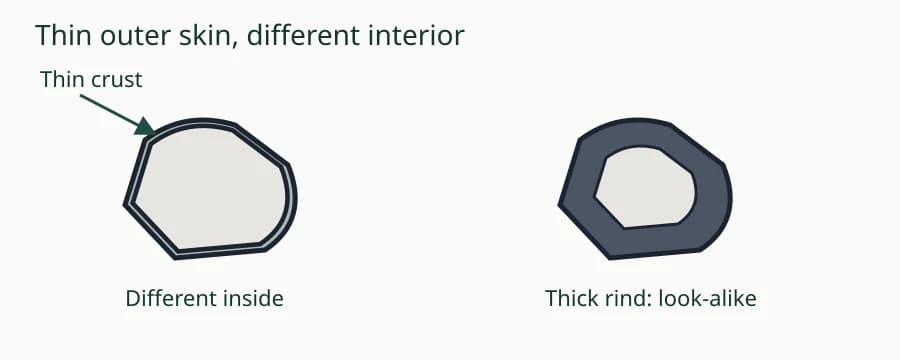
Look for a thin outer skin over an inside that looks different. Do not treat any black coating as proof. Desert varnish can cover a rock that also attracts a magnet, as ASU explains.
Some meteorites have regmaglypts, shallow dents that look like thumbprints. Others have flow lines, fine streaks left by melted crust as it cooled. Not all meteorites have these marks. A pit or a thick, wavy surface alone is not enough. ASU describes these surface features, while Randy Korotev at Washington University in St. Louis warns that not all dimples are regmaglypts.
No fusion crust? Your rock is almost certainly not a meteorite. Korotev notes rare exceptions, such as very old desert finds. But without crust, the other home checks do not give you a sound reason to call it a meteorite.
Magnet and Weight Checks
Use a simple ceramic refrigerator magnet, as Korotev advises, rather than a strong rare-earth magnet. See whether it is drawn to the stone. Check more than one side. Most meteorites show at least some pull, often around the whole piece. Iron meteorites pull strongly. Stony meteorites tend to pull less strongly, and some show no clear pull. A weak or absent pull does not settle the question: return to the crust.
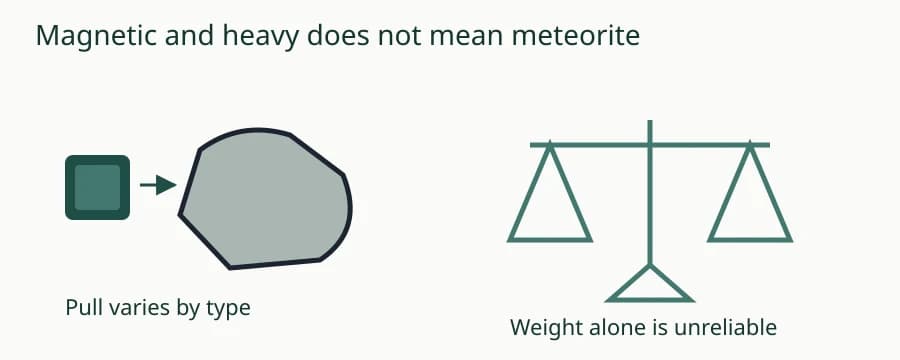
Magnetite is a common Earth mineral that attracts a magnet. Rocks that contain it and slag can also attract a magnet. Hematite is another common iron mineral. ASU notes that it is often found with magnetite. Arizona’s physical checks and the WUSTL cautions describe these look-alikes.
Does the stone feel heavy for its size? That may fit a meteorite, but dense Earth rocks and slag can feel heavy too. Density means how much mass fits in a given space. Stony meteorites may not feel much heavier than common rocks. Density alone is not a reliable home test.
If you need a magnet or streak plate, our mineral identification kit guide explains the tools.
The Streak Test on Unglazed Ceramic
A streak is the powder mark a stone leaves when rubbed across rough ceramic. Use an unglazed ceramic tile or streak plate. Rub a small spot of the stone across it and look at the mark.
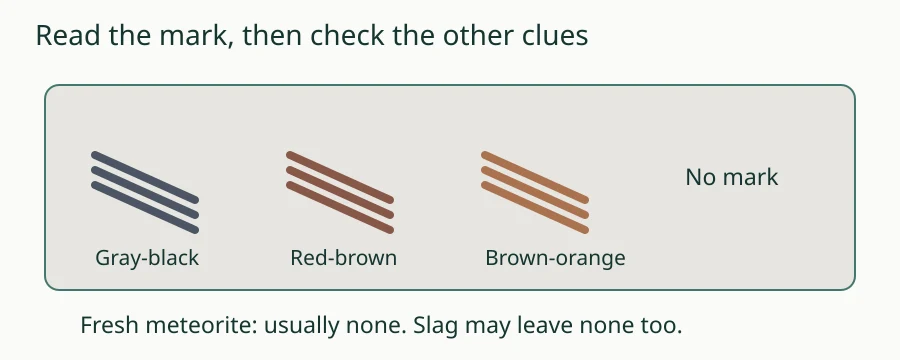
- No streak: fresh meteorites usually leave none. Slag may also leave none, so this is not a pass on its own.
- Gray to black: this fits magnetite.
- Red-brown: this fits hematite.
- Brown-orange: a weathered ordinary chondrite can leave this mark as its iron rusts. An ordinary chondrite is a common type of stony meteorite.
These results follow ASU’s streak guidance. Do not use the simple rule “any streak means no meteorite.” No streak does not prove a meteorite either. A magnetic stone with no streak and clear gas bubbles often points to slag.
Look Inside: Chondrules, Metal Flecks and Color
Start with an existing broken face, if there is one. Focus on a small area. Do not smash the whole stone to see inside. If a new window is needed, ask an expert how to preserve the sample first. This guide does not cover cutting or grinding it.
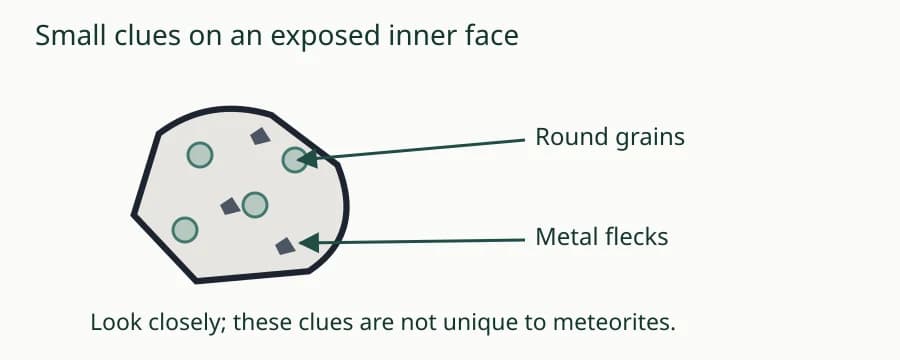
Chondrules are tiny round grains in many stony meteorites. The Arizona guide compares them to poppy seeds, about 1 mm across. Some are hard to see. Iron meteorites and some stony types have none. Round grains in an Earth rock can look similar, so a round grain is only a clue.
Most stony meteorites also have small metal flecks on an exposed inner face. Mica, a shiny mineral, and other crystal faces can give false metal glints. Use a magnifier to look closely. Our hand lens guide shows how to use a hand lens on a rock.
The inside usually looks different from the outer crust. Stony meteorite interiors can range from light gray to black. If the inside and outside have the same color and shade, that counts against a meteorite, though there are exceptions. These clues come from ASU, Arizona and Korotev’s cautions.
Signs It Is Not a Meteorite
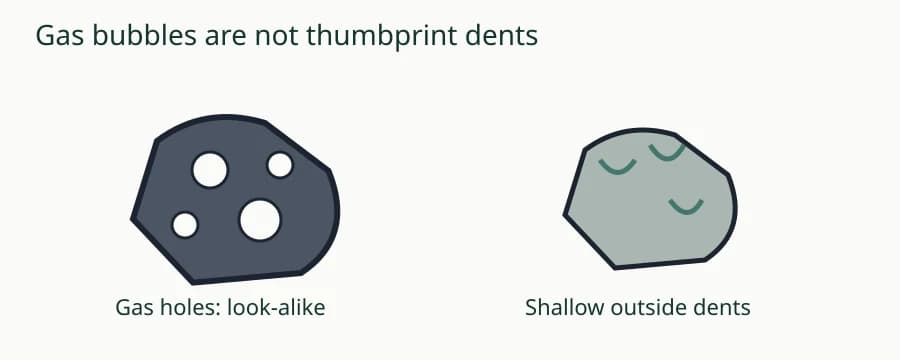
Vesicles are holes left by trapped gas. Large gas bubbles in a stony rock strongly count against a meteorite. Do not confuse them with shallow thumbprint dents on the outside. Arizona also flags an iridescent surface, a rainbow-like sheen, and large light crystals such as quartz. Low weight is another reason for doubt, though weight alone cannot rule every type out.
| Look-alike | Clue | Source |
|---|---|---|
| Slag | Waste from metal work. It can be heavy and magnetic, with gas bubbles and flow marks. It may leave no streak. | ASU |
| Magnetite | Strong magnetic pull, with a gray-black streak. | ASU |
| Hematite | Red-brown streak; often found with magnetite. | ASU |
| Basalt or other volcanic rock | A dark volcanic skin can mimic crust. Large gas bubbles favor a volcanic rock or slag. | Arizona |
| Desert-varnished rock | Shiny dark coating on an Earth rock; the rock beneath may also be magnetic. | ASU |
For slag vs meteorite, gas bubbles matter more than a dark color or magnetic pull. A thick rind, large quartz crystals or the same color inside and out also point away from a meteorite. There is no single home check that proves a stone came from space.
Meteorite Self-Test Checklist
This is a simplified screening path adapted from Randy Korotev’s WUSTL self-test checklist. His page credits an earlier flowchart by Debora Rios and colleagues at Nacional/UFRJ. The drawing here is our own. It does not copy their image or diagnose rare meteorite types.
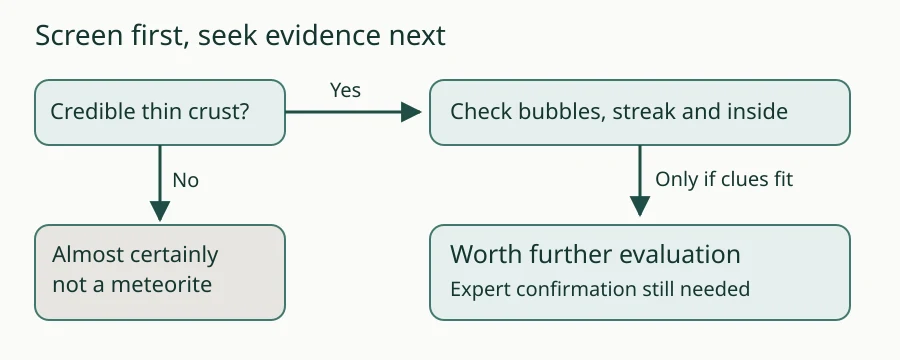
- Start with crust. No credible thin fusion crust means almost certainly not a meteorite. Stop treating the other traits as proof.
- Look for clear conflicts. Large gas bubbles, a thick rind or large quartz crystals point toward an Earth rock or slag.
- Record the other checks. Note magnetic pull, weight for size, streak color, and what you can see on an exposed inner face. Keep the limits of each test beside the result.
- If the clues still fit, seek further evaluation. Passing means only that the rock may be worth an expert’s time, perhaps with a chemical test. It does not mean it is a meteorite.
Do not use a phone app as the deciding check. Korotev warns that image apps, including Google Lens, cannot identify meteorites. A match in Google Images is not lab evidence either.
Found One on Public Land? What to Do Next
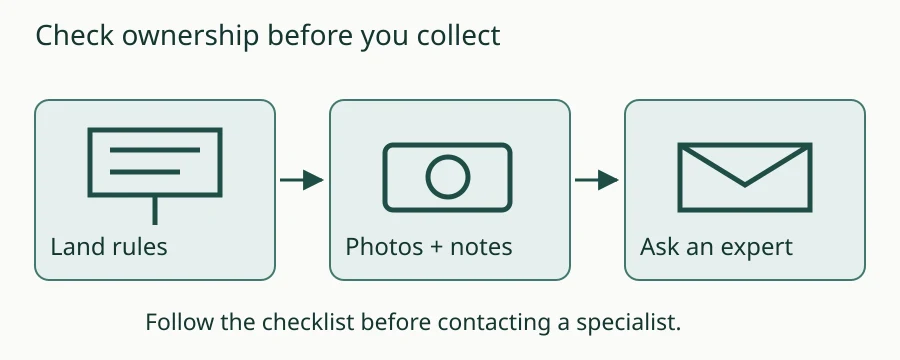
Check who manages the land before taking anything. The BLM’s meteorite FAQ (IM 2012-182) says meteorites belong to the owner of the surface land. On private land, get the owner’s permission. Finding a stone does not by itself settle ownership.
For casual hobby collection on BLM land open to that use, the FAQ sets these limits:
- No more than 10 lb per person per year, in specimens you can easily carry by hand.
- Surface collection only. No motorized or mechanical equipment; metal detectors are allowed.
- Personal use only. Casual finds cannot be sold or bartered. Within these rules, no collection fee or permit is required.
Open land does not mean all BLM land. The FAQ lists these closures:
- Developed recreation sites.
- Certain conservation units, including national monuments and national conservation areas.
- Areas closed by land-use plans, such as some wilderness areas and Areas of Critical Environmental Concern.
- Places closed by extra local rules.
Ask the local BLM office about the exact place before collecting. These are BLM rules. The FAQ says casual collecting is not allowed on land managed by the National Park Service, Bureau of Reclamation or U.S. Fish and Wildlife Service. For other land, ask its manager. Our guide to legal rock collecting helps you plan that check.
If your stone still fits the checklist, take clear photos of the outside and any exposed inner face. Record where you found it and the results of each check. Contact a meteorite expert at a university or museum. Explain why the crust and other clues seem to fit before asking for help. Korotev asks readers to do the checklist first and warns that busy experts may not reply.
The Meteoritical Society recommends expert evaluation and describes submitting a small sample. Ask the expert what they need before removing or mailing material. Arizona notes that identification may need chemical analysis and careful expert study. Home tests, photos and app labels cannot replace that confirmation.
Meteorite Identification FAQ
Short answers based on the sources above. Use the checklist before asking a meteorite expert about your stone.
What does a meteorite look like?
A fresh meteorite often has a thin black fusion crust. It may be dull or glossy. Older finds can be rusty brown. Most have no large gas bubbles. Looks alone cannot confirm a meteorite.
Do all meteorites stick to a magnet?
No. Iron meteorites have a strong pull. Many stony meteorites have a weaker pull, and some show no clear pull. Earth rocks and slag can also attract a magnet.
Can a phone app identify a meteorite?
No. Randy Korotev at Washington University in St. Louis warns that image apps, including Google Lens, cannot identify meteorites. An app label is not confirmation. Ask a meteorite expert about further tests.
Is a heavy black magnetic rock a meteorite?
Usually not. Slag, magnetite and rocks with desert varnish can share those traits. Check the crust, streak and interior too. Passing home checks only means the rock may be worth further evaluation.
Can I keep a meteorite I find on BLM land?
Only where casual collection is open and the BLM limits are met. The limit is 10 lb per person per year, from the surface, for personal use only. You cannot sell or barter casual finds. Check with the local BLM office first.
Your next step
Use the rules, then pick a site you can verify.
Recommended next step
Find a legal collecting site
Browse detailed location guides across the US.
Sources & References
- ASU: Meteorite characteristics — ASU Buseck Center for Meteorite Studies
- ASU: How can I find a meteorite? — ASU Buseck Center for Meteorite Studies
- Meteorite Physical Characteristics — University of Arizona Lunar and Planetary Laboratory
- Identifying meteorites — Randy Korotev, Washington University in St. Louis
- Do this first – Self-test checklist — Randy Korotev, Washington University in St. Louis
- FAQs on Meteorites on Public Land (IM 2012-182 attachment) — Bureau of Land Management
- Meteorites — Meteoritical Society
- Some meteorite realities — Randy Korotev, Washington University in St. Louis

Founder and editor, The Rockhounding Hub
Marvin runs this site and is still learning rockhounding. He builds each guide from maker specs, safety rules, and public sources.