
Table of Contents
Fluorite is the mineral species calcium fluoride. It is a classic collector mineral because it can be vividly colored, transparent, sharply crystallized, and sometimes strongly fluorescent, but the species-level identification still depends on physical properties more than color alone.
The two most useful clues are perfect cleavage and low hardness. A lot of beginners remember fluorite for purple or green crystals, but the more dependable field habit is to ask whether the specimen breaks on clean planes and whether hardness 4 makes sense for the material in hand.
Appearance & Identification
Fluorite is best identified by working from structure and hardness first, then treating color as supporting evidence.
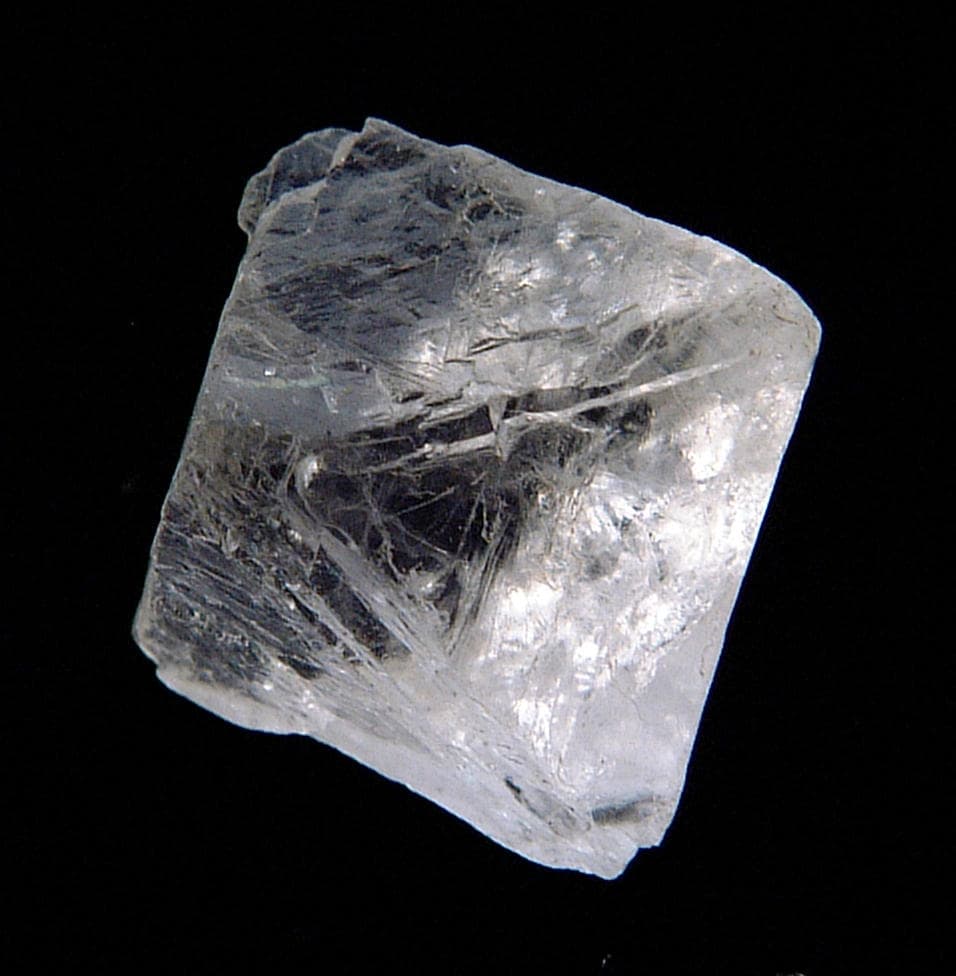
- Cleavage: Fluorite has perfect cleavage in four directions, which commonly produces octahedral fragments.
- Hardness: Fluorite has hardness 4, so it is clearly softer than quartz and only a little harder than calcite.
- Luster: Fresh crystal faces are usually vitreous.
- Crystal habit: Cubes and octahedra are classic, with combinations and stepped forms also common.
- Color: Colorless, purple, blue, green, yellow, orange, pink, brown, and zoned material all occur naturally.
- Streak: White.
How Fluorite Forms
Handbook of Mineralogy places fluorite in several settings, but for collectors the most important are hydrothermal veins and related mineral deposits. It also occurs in granites, granite pegmatites, syenites, carbonatites, alkaline intrusives, and as a cement in some sandstones.
That spread matters because fluorite is not tied to one narrow origin story. Some localities produce transparent cubes in open cavities, while others yield massive or granular fluorite intergrown with calcite, quartz, barite, sulfides, or other vein minerals.
Where Fluorite Is Found
Fluorite is worldwide. Handbook of Mineralogy lists notable occurrences in England, France, Switzerland, Germany, Spain, Russia, Kazakhstan, China, Mexico, and several U.S. states including New York, Ohio, Illinois, Tennessee, Colorado, and New Mexico.
In practice, collectors often encounter fluorite in mining-district and hydrothermal-vein contexts rather than as a casual rock-forming mineral. The species is common enough to be familiar, but fine transparent cabinet specimens still depend heavily on locality quality.
Similar Minerals & Lookalikes
Fluorite overlaps visually with several transparent or brightly colored minerals, but hardness and cleavage sort most cases quickly.
| Mineral | How to tell it apart from fluorite |
|---|---|
| Calcite | Calcite is softer at Mohs 3, reacts readily with dilute hydrochloric acid, and breaks into rhombohedral fragments rather than fluorite's octahedral cleavage pieces. |
| Quartz | Quartz is much harder at Mohs 7 and lacks cleavage. Fluorite is softer and breaks cleanly on perfect cleavage planes. |
| Dyed or imitation material | Fluorite comes in many colors naturally, but color by itself is never enough. Check for true cleavage, realistic crystal form, and the right softness before trusting a bright specimen. |
Beginner Tips for Collecting Fluorite
- Learn the breakage pattern. Octahedral cleavage fragments are one of fluorite's strongest field clues.
- Do not lean on color names. Purple helps you notice fluorite, but it does not confirm fluorite.
- Handle good crystals gently. Perfect cleavage means attractive specimens can chip more easily than beginners expect.
- Use associated minerals. Vein fluorite commonly turns up with quartz, calcite, barite, and sulfides.
- Check it in the dark. Plenty of fluorite glows under ultraviolet light — UV for short, the invisible light that makes some minerals shine. Not every piece does, so treat a glow as a bonus clue rather than proof. If you want to try it, our guide to UV lights for rockhounding explains which wavelength to buy first.
Before you go collecting…
Most beginners head out without knowing the basics. Our beginner’s guide covers gear, safety, and the field tests that’ll help you identify what you find.
Frequently Asked Questions
No. Fluorite's color range is enormous, so the most reliable field clues are perfect cleavage, Mohs hardness 4, vitreous luster, and the right geological setting.
Many fluorite specimens fluoresce under UV, and Handbook of Mineralogy notes that fluorite may fluoresce in several colors. Fluorescence can help, but it should support rather than replace standard identification features.
No. Cubes are classic, but octahedra and combinations are also common. Broken fluorite often shows cleavage fragments rather than preserved crystal faces.
Handbook of Mineralogy lists fluorite with quartz, calcite, dolomite, barite, celestine, sulfides, cassiterite, topaz, wolframite, scheelite, and apatite in many deposits.
Your next step
Now that you know fluorite, here’s the logical next move.
Recommended next step
Find collecting locations near you
Detailed field guides to rockhounding sites across the country.
Sources & References
- Fluorite — Handbook of Mineralogy
- Fluorite Mineral Data — Webmineral
- File:Fluorite (GeoDIL number - 2735).jpg — Wikimedia Commons