
Table of Contents
Feldspar is a mineral group, and that alone explains a lot of beginner confusion. Instead of one narrow mineral species, you are dealing with a family of extremely common rock-forming minerals that vary in chemistry, crystal symmetry, color, and subtle field behavior.
In plain terms, feldspar is a mineral group that dominates many of the rocks people pick up first, especially granites and pegmatites. Beginners struggle with feldspar because it is so ordinary, so abundant, and so often intergrown with quartz and mica that the eye stops too soon.
Appearance & Identification
Field-useful feldspar identification stays simple: learn the group clues before chasing every species name.
- Cleavage: Two good cleavage directions are the most useful general clue.
- Hardness: Usually about 6 to 6.5, harder than calcite but slightly softer than quartz.
- Luster: Vitreous on fresh surfaces and often pearly on cleavage faces.
- Color: Commonly white, gray, cream, or pink, with some green varieties such as amazonite.
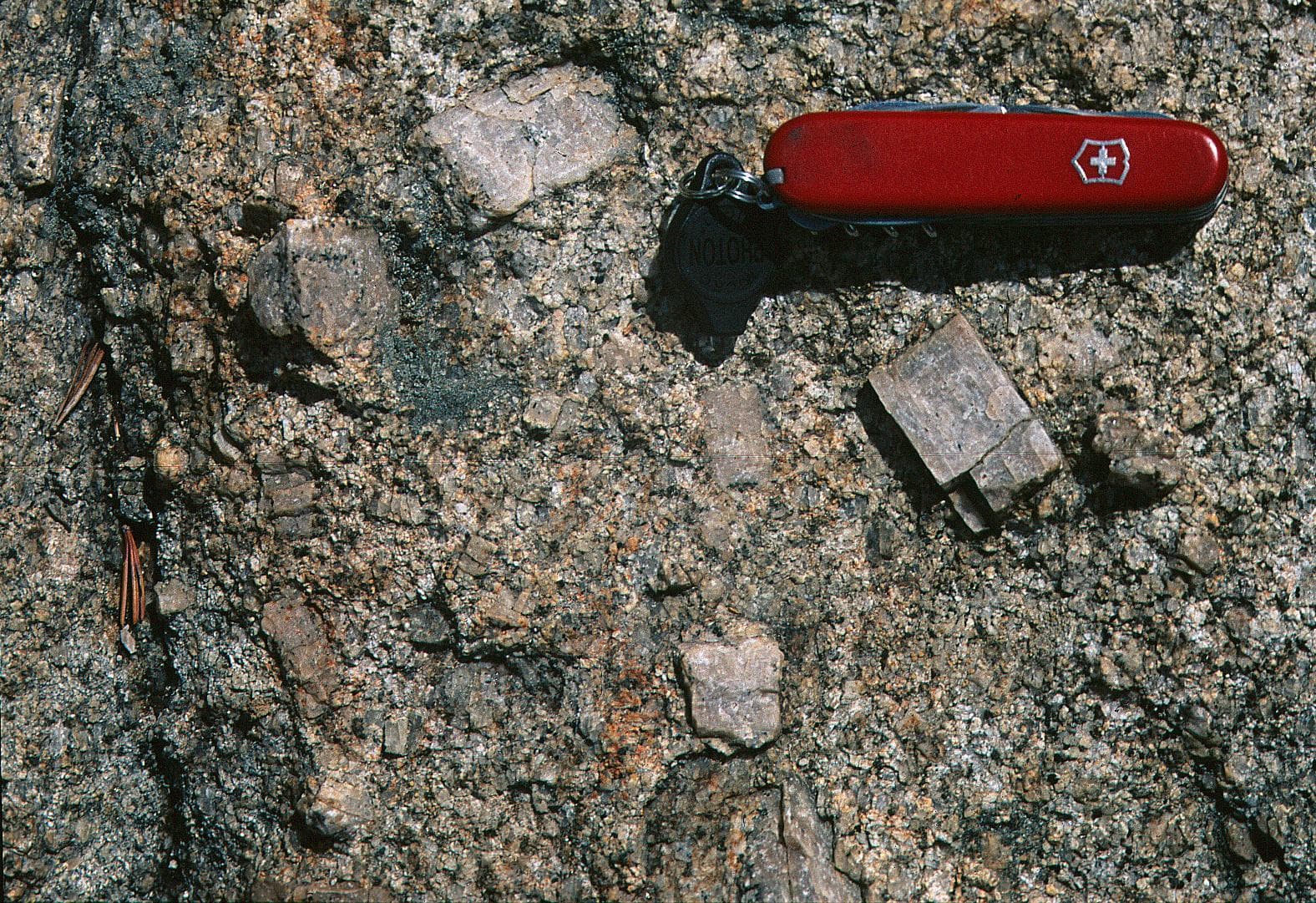
- Habit: Blocky grains and crystals are common, but in many rocks feldspar appears as interlocking masses rather than neat isolated crystals.
The Feldspar Group
USGS describes feldspars as a group of rock-forming tectosilicate minerals with potassium, sodium, and calcium endmembers. At the simplest field level, that means the two big branches are potassium feldspars such as orthoclase and microcline, and plagioclase feldspars such as albite and anorthite-rich members.
Orthoclase is monoclinic and Handbook of Mineralogy lists it with perfect cleavage and hardness about 6 to 6.5. Albite, a plagioclase feldspar, is triclinic and also shows strong cleavage and similar hardness. That is why group-first identification is more useful for most collectors than pretending one quick glance can resolve every feldspar.
How Feldspar Forms
Feldspars are major constituents of igneous rocks and remain important through metamorphism and sedimentary recycling. Handbook of Mineralogy lists orthoclase and albite in granites, pegmatites, hydrothermal veins, metamorphic rocks, and sedimentary settings.
For collectors, granites and pegmatites are the easiest places to think about feldspar because large crystals and interlocking textures are so common there. In everyday outcrops, feldspar is less a curiosity than a framework mineral helping make up the rock itself.
Where Feldspar Is Found
Feldspar is effectively everywhere in the continental crust. USGS treats feldspar as a major rock-forming group, and that is exactly how collectors should think about it: not as a rare locality mineral, but as one of the main ingredients of common rocks.
Good collector crystals come from pegmatites, alpine veins, and some granitic environments, but ordinary feldspar grains and masses are far more widespread. That gap between common occurrence and specimen quality is part of why feldspar feels familiar yet still gets misidentified.
Similar Minerals & Lookalikes
Quartz is the main beginner confusion case, with calcite and generic pale rock-forming minerals trailing behind.
| Mineral | How to tell it apart from feldspar |
|---|---|
| Quartz | Quartz lacks cleavage and is harder at Mohs 7. Feldspar usually shows two cleavage directions and looks less glassy on broken surfaces. |
| Calcite | Calcite is much softer and reacts with acid, while feldspar is harder and does not fizz. Calcite cleavage fragments are rhombohedral rather than blocky. |
| Massive granite components | In coarse igneous rocks, beginners often confuse quartz and feldspar because both can be pale and intergrown. Cleavage and hardness are the main separators. |
Beginner Tips for Collecting Feldspar
- Check cleavage every time. That is the fastest way to stop confusing feldspar with quartz.
- Use the whole rock. Granite, pegmatite, and gneiss context often makes feldspar more obvious.
- Learn orthoclase and plagioclase gradually. Group confidence comes before species-level confidence.
- Expect it to be common. Familiarity is part of the skill with feldspar, not a reason to ignore it.
Before you go collecting…
Most beginners head out without knowing the basics. Our beginner’s guide covers gear, safety, and the field tests that’ll help you identify what you find.
Frequently Asked Questions
Feldspar is a mineral group. USGS describes feldspar grains as a group of rock-forming tectosilicate minerals with potassium, sodium, and calcium endmembers.
Because feldspar is extremely common, often pale colored, and commonly intergrown with quartz and mica in everyday rocks. Many beginners see a light-colored crystal and stop before checking cleavage.
Look for two good cleavage directions and hardness near 6. Orthoclase and albite both show strong cleavage, while quartz does not.
Not always. At a beginner level it is usually enough to recognize feldspar confidently first, then learn high-level differences such as pink K-feldspar versus striated plagioclase surfaces.
Your next step
Now that you know feldspar, here’s the logical next move.
Recommended next step
Find collecting locations near you
Detailed field guides to rockhounding sites across the country.
Sources & References
- Oxide and Cation Compositions of Feldspar Grains from Drill Core of the Duluth Complex, Minnesota — USGS
- Orthoclase — Handbook of Mineralogy
- Albite — Handbook of Mineralogy
- File:K-feldspar (GeoDIL number - 2210).jpg — Wikimedia Commons